Showing posts with label Ballarat. Show all posts

Saturday, August 26, 2017

Clunes, Victoria


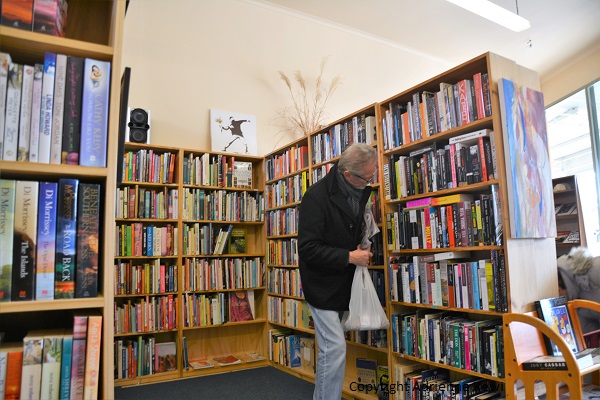
Clunes is all about books. The annual Clunes Booktown Festival is proof of that, when, in April-May, over 50 visiting book traders from around Australia join forces with the town’s seven permanent bookstores to present what many have called “an unequalled weekend of book browsing.”

That’s when thousands of secondhand, collectible, small press and out-of-print books go on sale; and people can attend workshops and author talks. It’s a book bonanza and anyone who loves books finds their own little piece of rural Victorian Heaven.


    There are around 22 international members of  the International Organisation of  Booktowns ( www.booktown.net) and Clunes is the first in Australia and one of only two in the Southern Hemisphere (at time of writing). [The other is Featherston, New Zealand]. During the Booktown Festival, the town’s main street is closed to traffic and the usual population of around 1,700 swells to an impressive 18,000 or more.

Booktowns are a European concept and by definition, a booktown is “a small rural town or village with a concentration of secondhand and antiquarian bookshops.” Clunes became a member of the international organisation in 2012.

All this is what drew me to Clunes. I’m a book lover and I’d heard a lot of positive things about the little town, which owes its existence to the Victorian goldrush. It’s an historic gold mining town, located in the heart of Victoria's Central Goldfields region, just north of Ballarat and about an hour and 20 minutes’ drive west of Melbourne CBD. 


I arrived ‘by the back door’ – a short cut from Blampiad that wound through a fascinating rolling, agricultural landscape peppered with startling green cones (old extinct volcanoes) dotting the horizon, and the relics of old mining buildings and dredging piles.

And suddenly, there I was, driving passed a bedraggled array of houses on the outskirts of town on a day that what was clearly close to inorganic rubbish collection day – big heaps of domestic dross piled at gateways waiting for collection. It wasn’t a tantalizing beginning.

But the Clunes State School 1552 was. Its impressive form dominated the end of Canterbury Street (where it met Paddock Street – which for no reason at all, amused me immensely). I was just beginning to think ‘this was it’ when I rounded a corner and came face-to-face with the quaintest little streetscape I’d seen in ages….well….since Maldon at least.
·     


·        
There’s a ‘Wild West’ element to it all and it wasn’t surprising at all to learn that, like Maldon, Clunes is sought-after by film-makers as a location. In Clunes’ case there have been many but when Mel Gibson and his team arrived in town to film “Mad Max,” [1979], they set off a chain of events that continues today – in much the same way as “Lord of the Rings” fans descend upon the New Zealand movie sets, “Mad Max” fans arrive in Clunes on their motorbikes, park outside the pub and sit down for a beer and a yarn about the movie.

“When the War Began, “Doctor Blake,” “Ned Kelly,” “On The Beach,” “Halifax f.p and the recent remake of “Picnic at Hanging Rock” were all also filmed in part or their entirety at Clunes.

Many of the original old gold rush buildings are still standing and ‘in good working order’ and although it was quiet when I arrived at 10am, I could see why it was becoming increasingly popular. I liked its unhurried air, its sense of rural comraderie, evidenced in friendly smiles and happy hellos. As corny as that sounds, it’s a noticeable thing in small town Australia that I really enjoy. People are happy to stop for  chat, even when they don't know you.


Even as the day wore on, and locals and visitors fell upon the cafes like thirsty camels in a desert, the locals were still stopping in the street to chat – and when I say “stopping in the street,” I mean it literally. No one seemed at all bothered about the fact that roads were actually designed for cars


While I began this little tale by saying ‘Clunes is all about books,’ it is also without a doubt, about the people and the architecture. With every small Victorian town I visit, I am surprised all over again by the wealth of well-preserved old buildings, their scale and their presence in sometimes very small communities. And the revival of small-town Australia is flourishing. For Clunes, it’s been on the back of film sets, its Booktown Festival and to a degree, the decision by Wesley College, Australia's largest co-educational private school, to establish a campus for Year 9 students in the town.

Opened in 2000, about 80 students take up residency in the Wesley Clunes Residential Learning Village in the centre of town and become part of the local community for an eight-week period each term, where they learn how to take care of themselves in preparation for an independent adulthood. I couldn’t think of a better place to do that.
www.clunesbooktown.com.au


Tuesday, June 6, 2017

Ballarat, Victoria

Ballarat University Buildings
Ballarat Railway Station
Not long after you pass the big orange sign saying “You are entering Wadawurrung Country,” you pass Pistol Club Road and a “Honey for Sale” sign, then it’s a straight run south (from Daylesford), to the semi-industrial beginnings of Ballarat.
It’s always a puzzle to me that, in an attempt to meet all the needs of modern western society, all the service industries are allowed to clutter up the main approaches into our cities. The brick works, the flooring manufacturers, the transport depots – you name it, they’re all there, lining the streets that take us into our city hearts. It’s hardly enticing. Why can’t they be hidden out the back somewhere? Why can’t we have more appealing leafy avenues showing the way like they do in so many small towns?

But I digress. I went to Ballarat for the first (and only other time), in 2010 – a trip most memorable for two things – the fabulous railway station buildings and rather unfortunate ‘accident’ I had when, distracted by the surrounding architecture, I plonked myself down on a step that wasn’t actually there. The pain was sickening and as I sat there, immobile, on the unyielding stone pavement, I wondered if I’d ever walk straight again. This trip could only be an improvement - as long as I kept my wits about me.


If you like architecture, it’s not hard to like Ballarat. The place is awash with splendid buildings that speak of the city’s early wealth. It was a gold rush boom town. Located on the Yarrowee River in the Grampians region of Victoria, it transformed from a small sheep station to a major settlement after gold was first discovered – rather ironically – at Poverty Point - on 18 August, 1851. News spread fast and suddenly every man and his dog wanted to try their hand at gold prospecting. Within months, migrants from all around the world had arrived.

Long, long before that though, this was Wadawurrung territory (and it still is). Their traditional lands spread 3,000 square miles across what are today the Geelong, Ballarat and Bellarine areas.

The Wathaurung Aboriginal Corporation (WAC), trading as Wadawurrung, is the Regional Aboriginal Party (RAP) for Wadawurrung country. It has a statutory role in the management of Aboriginal heritage values and culture within the region under the Victoria Aboriginal Heritage Act of 2006. An Act if I may say, that seems very recent given Aborigines have peopled this land for thousands of years.

I was only in town for a short time – and I was on a specific mission – so I guess I shouldn’t be surprised that I didn’t see a lot of overt references to the Aboriginal history of the place. Apart from an Aboriginal painting on the wall at my first coffee stop and a street art painting of an Aboriginal girl, I saw nothing. But I’m sure it’s all there.


The architecture however, cannot be missed. The city is well known for its well-preserved Victorian heritage and there’s a grandeur and opulence to both the commercial buildings and much of the city’s housing. It dominates every corner and is a clear show of the confidence early settlers had in their city.

The references to gold are all around too and one area of town – Sovereign Hill - is given over to an outdoor museum where visitors can experience the history and excitement of the gold rush era. You can pan for a speck of gold, explore underground mines, visit the Gold Museum and watch Redcoat soldiers (actors in uniform), firing muskets in ways that bring the now-famous Eureka Rebellion of 1854 to mind.

Often known as the Eureka Stockade, the uprising was fought between miners and colonial forces – the only armed rebellion in Australian history in fact. I’m not certain what the miners were revolting against but the military stepped in. The red-coated British soldiers’ role prior to that, had simply been to escort gold safely to Melbourne.


Personally, I’d rather watch jelly set than sit through the re-enactment of some historic battle, so I by-passed Sovereign Hill. Perhaps another time. But I have spent some time day-dreaming about the Welcome Nugget, which was found at Bakery Hill in Ballarat in 1858 by 22 miners. It is still the second largest gold nugget found anywhere in recorded history.

To call it a ‘nugget’ in fact, is a perfect piece of Australian under-statement. It actually weighted 68.98 kilograms – more of a gold boulder than a gold nugget; and it is reported that the first two men to find it fainted at the sight of it. True or not, I completely understand.
A year after it was found, it was melted down by a London mint to make gold coins – but not before several replicas were made, which are now on display in museums in Sydney, Melbourne, Ballarat and even in the Mineralogical Museum at Harvard University in Cambridge, Massachusetts. 

So that’s Ballarat’s key historical points in a nutshell. I do regret not having time to visit the Ballarat Botanical Gardens – home to the greatest concentration of public statuary in Australia. This includes the Prime Ministers’ Avenue, where bronze casts of all of Australia’s Prime Ministers feature in a leafy walkway. In fact, within the last week, Tony Abbott was there, giving the thumbs-up to his bronze – the latest in a long line.


But I’ll be back and maybe then, I’ll also find time to chat with some Ballaratians, as they’re known, to find out what they think of their splendid little city.
Related Posts Plugin for WordPress, Blogger...