Showing posts with label History. Show all posts

Sunday, February 18, 2018

Armadale, Melbourne – Victoria


When you stand in High Street, Armadale – constantly written about as the epitome of contemporary style and one of Melbourne’s premier blue chip areas – it’s hard to imagine it when it was first settled in the 1850s. Back then, it comprised market gardens and nurseries with a few housing allotments against a bush backdrop.


History notes that it wasn’t until the 1880s, that the boom years came with the first trains into the area. Then, the land was sub-divided for commercial and residential development and by 1890, High Street was populated by bootmakers, tailors, dressmakers, milliners, wheelwrights, blacksmiths, green grocers, upholsterers, iron mongers and the like – a far cry from today’s stylish fashion boutiques and the plethora of Persian rug shops, antique stores, nail and hair boutiques and bridal parlours that line the main Armadale thoroughfare; and the millions of dollars’ worth of high-end cars that park there.


I stayed in Armadale in December 2017-January 2018. I drove into the cool, leafy, tree-lined residential streets, parked my car outside the villa where I was staying and spent the next three weeks walking and photographing. I fell in love with so much of the residential architecture – the huge old homes that lined the streets – usually tucked away behind trees and high brick walls and impenetrable gates – but just enough visible to pique my interest and set me wondering about some other grand lifestyle.


I slipped over into neighbouring Toorak – long recognised as Melbourne’s top suburb – and into adjoining Malvern, Hawthorne and Prahran; all of them known for their expensive real estate. And in every street, I found a house that, externally at least, set me to dreaming and to wondering what it might be like inside.


I’ve always loved big houses and it was only a matter of time before I found a way to explore further – albeit via a computer. Turns out it’s relatively easy to get a glimpse inside many of these enormous, multi-million dollar homes – you just look the address up on the Internet and if they’ve been sold within the last decade, there’s usually a record of transactions, often with real estate photographs supplied. Much less satisfying than an actual house tour but enough to give you a hint of the interior of a $14-million home you wouldn’t otherwise see inside. And yes, I did feel like a nosy pauper – but only for a very short time.


Contrary to (my) expectations, Armadale is also a suburb of apartment blocks – new and old. Its proximity to central city has always made it a popular place to live and I liked the way apartment blocks of all ages sat comfortable and appropriately, side-by-side with top-dollar houses – integrated, appealing.


 Armadale is sited 7 kilometres southeast of Melbourne’s central business district on what was once part of Wurundjeri land. The 2016 census indicated a population of around 9,000 residents; and it was named after Armadale Sutherland, in Scotland, where the 15th Premier of Victoria, James Munro was born.

It’s a pleasant place to be – from a residential point of view; but the neighbour’s don’t seem that neighbourly nor trusting, tucked away as they are behind their impenetrable high walls and gates with security cameras and microphones to see ‘who’s knocking.’ I guess it’s one way to keep unsolicited ‘doorknockers’ away from your actual door. 
And I certainly did feel  SECURE.


But there’s also something about the pristine, rigidly maintained streets and sections that left me cold. For all the fabulous old architecture, for all the high fashion, expensive, designers, bridal boutiques, antiques (expensive) and posh restaurants, I found these wealthy suburbs lacking in character -  no graffiti to speak of, no rough edges, very few book shops, no grunge, no mess....it's all a bit sanitised for me and my photographic eye. I prefer places that are bit more rough around the edges. Places more ordinary.
Places that encourage people to lives with gusto and colour.

Sunday, December 3, 2017

Lyonville – Victoria


I couldn’t count the number of times I’ve driven through the edges of the little settlement of Lyonville on my way to other places.

It’s the ‘so-small-sort-of-place’ that could be missed entirely on a quick drive to Daylesford. A mere spot on the map. Perhaps. If the map is a very detailed one.
The tiny hamlet – population a grand 175 in 2016-  sits in the Shire of Hepburn 5km northwest of Trentham (also small), and 80km northwest of Melbourne. It’s near the headwaters of the Lodden River and on the edge of the Wombat State Forest.


It began life as a sawmilling town in the 1860s to supply timber to the Ballarat and Bendigo goldfields; and at its peak, it had three hotels, several shops, a public hall, a school, three churches and a railway station. By comparison today, it is a ghost town. Little remains from that time apart from a few derelict relics and a town history map that marks former locations in the manner of: Ogden Brothers Mill (Site of), Eucalyptus Stills (Site of), Primary School (Site of).


It was that little old school ruin that drew encouraged me to drive the ten minutes from home. I’d seen a photo someone took of it on social media and I fell in love with it as a potential art studio. It seemed perfect from afar. And as dreams are free, I decided to find it. I figured it wouldn’t be hard in a place as small as Lyonville. And, as luck would have it, I found it in the first street I turned into off the main highway – sitting among the long green grass just waiting for someone to love it.

I’ve since found out that the school opened for millers’ children in 1877 and was originally called Lyon’s Steam Sawmills School – the town itself was named after John Lyon, who arrived in the district in the 1860s and obviously wasn’t shy about naming things after himself.

The old building is as cute as a button, no doubt about that. But it isn’t currently for sale and the realities of uplifting it and transporting and then renovating it quickly put me off it – in a practical sense; though naturally I still harboured the dream as I dawdled my way around the little network of Lyonville streets.


Calling them streets seems a bit of a stretch actually. They’re more your pretty, leafy country lane – narrows thoroughfares bordered by lush, lime green foliage, and great drifts of honeysuckle and blackberry, shining in the aftermath of three days rain. Lots of abandoned fruit trees and orchards with patrolling geese. I can see why increasing numbers of people are drawn to the place.

I saw no one, heard no vehicles. There are no shops, no schools, no noise apart from the birds. That in itself is a charm for many people and the growing number of new houses springing up among the old cottages, is testament to the settlement’s growing popularity as a rural retreat.


The old Radio Springs Hotel (circa 1927), is one of the few large landmarks from earlier settlement days. Even that was stone quiet. It had been closed for fifteen years when an enterprising couple purchased it and renovated to re-open in 2009. Since then, it’s been providing accommodation – along with a growing number of B&Bs in the area – for people who want to be close to Daylesford for a weekend of shopping and exploring. Inside, the rooms are appealing and you can spend a night for $200-$250.
Radio Springs Hotel


There’s a dog bowl outside – with four blue chairs – and two tyre pressure checkers – at least I think that’s what they were. They wouldn’t have been high on my list of hotel requirements but there you go.
The old railway station

The Town Hall
 I drove to the Railway Station next – Site of! A couple of the buildings are still there….to accommodate some sort of tourist train that runs from time to time I think. The original station opened in 1880 to connect the town with Daylesford and Woodend; it closed in 1978. On that note, the Lyonville Post Office opened in 1882 and closed in 1993.

The Old Town Hall – surprisingly – is still there and operational. This is thanks to the good going over it received to the tune of $135,000. The hall is a focal point for community activities. It hosts the annual Firemans’ Ball, Christmas Carols, an annual Bake-off and wood chop, plus small theatre shows, live music and weddings.


I side-tracked then, taking the road to Lyonville Mineral Springs. I’ve noted this sign for at least five years. This time I decided to satisfy my curiosity. Within minutes I was in the middle of huge stands of (very beautiful) Candlebark forest – part of the Wombat Sate Forest. It was dark, gloomy and very, very quiet. I was immediately reminded of my horror trip into the Lederderg Forest but least this road was sealed and the sign had said the springs were only 2km away.

This turned out to be another case of “Site of.”


The stone-lined pit for the springs is still there, with a very murky depth of water fenced off. I imagine it would take a lot to tempt anyone into it these days. That said, they were once “a Lyonville highlight.”

Discovered in 1912 and declared a reserve in 1914, the springs were apparently rich in carbonates, chlorine, magnesium and other trace elements and people visited from miles around. Unfortunately, by the middle of the 19th century, the landscape covering the basalt aquifer that supplied the springs with much of their water, had been cleared for agriculture and the springs days were thereafter numbered.

I stood there, in the silence of the candlebarks, looking at the historical photographs of people dressed in their best Victoria clobber – so impractical for the Australian bush – and tried to imagine what it might have been like to visit and immerse oneself in the murky mineral waters. My involuntary shudder told me all I needed to know.


I photographed gum trees on the way back to the main road, imagining all the paintings these gorgeous trees were going to inspire. Out on the main road, I sniggered, as I always do, in juvenile amusement at the sign for Peukers Lane. No doubt it was named for someone important and probably very pleasant, so it’s inappropriate perhaps, that it always reminds me of a good number of parties I’ve attended, that ended with unpleasant after effects.

Saturday, August 26, 2017

Clunes, Victoria


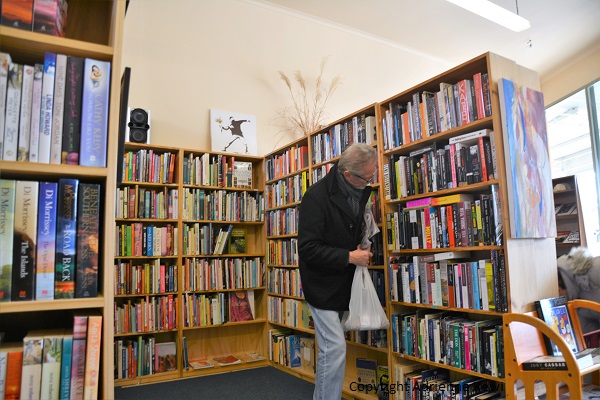
Clunes is all about books. The annual Clunes Booktown Festival is proof of that, when, in April-May, over 50 visiting book traders from around Australia join forces with the town’s seven permanent bookstores to present what many have called “an unequalled weekend of book browsing.”

That’s when thousands of secondhand, collectible, small press and out-of-print books go on sale; and people can attend workshops and author talks. It’s a book bonanza and anyone who loves books finds their own little piece of rural Victorian Heaven.


    There are around 22 international members of  the International Organisation of  Booktowns ( www.booktown.net) and Clunes is the first in Australia and one of only two in the Southern Hemisphere (at time of writing). [The other is Featherston, New Zealand]. During the Booktown Festival, the town’s main street is closed to traffic and the usual population of around 1,700 swells to an impressive 18,000 or more.

Booktowns are a European concept and by definition, a booktown is “a small rural town or village with a concentration of secondhand and antiquarian bookshops.” Clunes became a member of the international organisation in 2012.

All this is what drew me to Clunes. I’m a book lover and I’d heard a lot of positive things about the little town, which owes its existence to the Victorian goldrush. It’s an historic gold mining town, located in the heart of Victoria's Central Goldfields region, just north of Ballarat and about an hour and 20 minutes’ drive west of Melbourne CBD. 


I arrived ‘by the back door’ – a short cut from Blampiad that wound through a fascinating rolling, agricultural landscape peppered with startling green cones (old extinct volcanoes) dotting the horizon, and the relics of old mining buildings and dredging piles.

And suddenly, there I was, driving passed a bedraggled array of houses on the outskirts of town on a day that what was clearly close to inorganic rubbish collection day – big heaps of domestic dross piled at gateways waiting for collection. It wasn’t a tantalizing beginning.

But the Clunes State School 1552 was. Its impressive form dominated the end of Canterbury Street (where it met Paddock Street – which for no reason at all, amused me immensely). I was just beginning to think ‘this was it’ when I rounded a corner and came face-to-face with the quaintest little streetscape I’d seen in ages….well….since Maldon at least.
·     


·        
There’s a ‘Wild West’ element to it all and it wasn’t surprising at all to learn that, like Maldon, Clunes is sought-after by film-makers as a location. In Clunes’ case there have been many but when Mel Gibson and his team arrived in town to film “Mad Max,” [1979], they set off a chain of events that continues today – in much the same way as “Lord of the Rings” fans descend upon the New Zealand movie sets, “Mad Max” fans arrive in Clunes on their motorbikes, park outside the pub and sit down for a beer and a yarn about the movie.

“When the War Began, “Doctor Blake,” “Ned Kelly,” “On The Beach,” “Halifax f.p and the recent remake of “Picnic at Hanging Rock” were all also filmed in part or their entirety at Clunes.

Many of the original old gold rush buildings are still standing and ‘in good working order’ and although it was quiet when I arrived at 10am, I could see why it was becoming increasingly popular. I liked its unhurried air, its sense of rural comraderie, evidenced in friendly smiles and happy hellos. As corny as that sounds, it’s a noticeable thing in small town Australia that I really enjoy. People are happy to stop for  chat, even when they don't know you.


Even as the day wore on, and locals and visitors fell upon the cafes like thirsty camels in a desert, the locals were still stopping in the street to chat – and when I say “stopping in the street,” I mean it literally. No one seemed at all bothered about the fact that roads were actually designed for cars


While I began this little tale by saying ‘Clunes is all about books,’ it is also without a doubt, about the people and the architecture. With every small Victorian town I visit, I am surprised all over again by the wealth of well-preserved old buildings, their scale and their presence in sometimes very small communities. And the revival of small-town Australia is flourishing. For Clunes, it’s been on the back of film sets, its Booktown Festival and to a degree, the decision by Wesley College, Australia's largest co-educational private school, to establish a campus for Year 9 students in the town.

Opened in 2000, about 80 students take up residency in the Wesley Clunes Residential Learning Village in the centre of town and become part of the local community for an eight-week period each term, where they learn how to take care of themselves in preparation for an independent adulthood. I couldn’t think of a better place to do that.
www.clunesbooktown.com.au


Thursday, August 3, 2017

Maldon, Victoria


I’d heard a lot about Maldon, long before I ever went there. “You’ll love it,” someone said.
“It’s just the prettiest place, so many lovely old buildings – I’d live there in a heartbeat,” said someone else.

“It has a great sense of community and well-priced real estate,” and so on and so on.
So last weekend, I set off, expectations high and eager to see what I would make of this new place.

It wasn’t a long drive – just 40 minutes or so from where I live and just ten minutes northwest of Castlemaine (140km NW of Melbourne for those who want a bigger landmark). It sits on the slopes of Mt Tarrengower in the middle of an agricultural, pastoral and mining region in the heart of the Victorian goldfields region.


 Gold was found there in 1853 and within a month 3,000 miners had arrived at the Tarrengower Fields to try their luck. Another month after that, the population was said to be around 18,000. These days, it’s a more modest 1,500 or so but everything they say about the town being little changed from the 1850s is true.

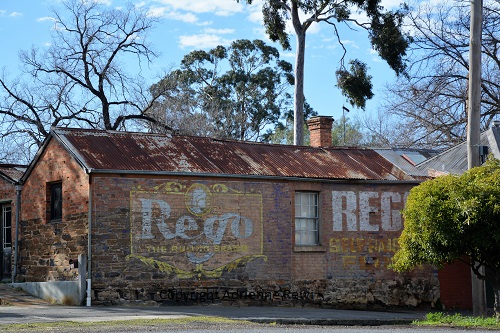
My head spun in every direction trying to take in all the old gems, all the old typography preserved on the outside of so many of them. It was a little like stepping back in time and easy to see why the 2007 Australian film,” Romulus, My Father,” set in the 1950s was shot there. It was also easy to see why the National Trust of Australia declared it Australia’s first Notable Town in 1966 – this on the basis of its well preserved goldmining era buildings and the number of different architectural styles that make up the settlement.


From the outset, it was all about the architecture for me; but there was something else too, an ‘intangible essence’ about the place that I loved. As someone said after my visit, “it’s genuine old world and it hasn’t been hijacked by gourmands and pretensions.” I couldn’t have put it better myself. The locals were friendly and there were boutique stores and cafes aplenty but I never got the feeling they were trying hard to be trendy. They just seemed to be going about their business – unhurried and unworried about what ‘the outside world’ thought of them. It was refreshing and I slowed my pace to fit the mood of the place.


This is a town designed for the leisurely amble and with the sun warming my back, I went from shop to shop, café to café and into everything in between. There were numerous antique and collectible shops, the prerequisite craft/interiors places, an art studio or two, a terrific print shop, an amazing shop filled with antique lace and linens, a traditional lolly shop, a deli, a car garage and mechanics repair shop right beside a patchwork quilt and fabric store, a Christmas shop (!!), the traditional old grocer with an amazing town noticeboard outside and at least two wonderful independent bookshops.
(Independent bookshops seem to be very well represented in small Victorian towns. I haven’t been in one town yet that doesn’t have at least one excellent and very enticing bookshop – and long may that be the case).


I gazed longingly at the Maldon Hotel and its beautiful iron fretwork balconies and wondered what wonders and small town secrets might play out in its Clydesdale Room. I noted they offered a range of lunches – curried sausages $12; beef lasagne $15 - with an invitation to step inside and partake. I watched a steady trail of people going into the tiny bakery, some lingering for coffee at the outside tables, others clutching their brown bags full of edible goodies, some sitting down on the public bench seats because they obviously couldn’t wait to go any further before eating.

And I stood, gazing in awe at the huge pomegranate tree that spread over the bakery roof and adjacent courtyard. I’d never seen a pomegranate tree before and initially, I thought the bright red globes hanging from its bare branches were apples. Unseasonal I thought, but then, it was much warmer here (19-degrees), roses were still blooming and all the yellow wattles were in bloom – so why not apples? It wasn’t until I put my glasses on that I noticed the burst fruits and the millions of seeds spilled over the ground below, that I realised they were pomegranates – and I couldn’t stop thinking about the waste, and how I would have paid NZ$7-8 for a single pomegranate in a New Zealand supermarket.


The locals hardly seemed to notice. Perhaps they all had pomegranate trees in their home gardens? It seemed as good a reason as any, to get into my car and explore the residential streets. Like so many of these old Victorian mining towns, the housing stock is right up my romantic, idealised alley – all colonial villas, iron fretwork and cool, generous verandahs and balconies for those hot Aussie afternoons. Forget the nightmares of repairs, renovations and maintenance, I cling to the dream of characterful architecture equalling the perfect, inspirational retreat laced with history and intrigue, and I won’t be told otherwise.


 I did spot one lovely property for sale – Robinson House (above, top right), Circa 1864 – a cute Gothic, double-brick home with 13-foot ceilings. I sat awhile on the roadside imagining myself living there – sweeping its polished floors, lounging in its spacious sunroom, pottering in the garden, shivering in its hard-to-heat rooms. I’ve imagined worse things, lived in worse places. Somehow though, I don’t think I’ll be moving any time soon. That would take at least two pomegranate trees, a mango orchard, three fig trees and an avocado tree.
But I will very definitely be visiting again.
There's plenty more to see yet.
Related Posts Plugin for WordPress, Blogger...