Sunday, December 3, 2017

Lyonville – Victoria


I couldn’t count the number of times I’ve driven through the edges of the little settlement of Lyonville on my way to other places.

It’s the ‘so-small-sort-of-place’ that could be missed entirely on a quick drive to Daylesford. A mere spot on the map. Perhaps. If the map is a very detailed one.
The tiny hamlet – population a grand 175 in 2016-  sits in the Shire of Hepburn 5km northwest of Trentham (also small), and 80km northwest of Melbourne. It’s near the headwaters of the Lodden River and on the edge of the Wombat State Forest.


It began life as a sawmilling town in the 1860s to supply timber to the Ballarat and Bendigo goldfields; and at its peak, it had three hotels, several shops, a public hall, a school, three churches and a railway station. By comparison today, it is a ghost town. Little remains from that time apart from a few derelict relics and a town history map that marks former locations in the manner of: Ogden Brothers Mill (Site of), Eucalyptus Stills (Site of), Primary School (Site of).


It was that little old school ruin that drew encouraged me to drive the ten minutes from home. I’d seen a photo someone took of it on social media and I fell in love with it as a potential art studio. It seemed perfect from afar. And as dreams are free, I decided to find it. I figured it wouldn’t be hard in a place as small as Lyonville. And, as luck would have it, I found it in the first street I turned into off the main highway – sitting among the long green grass just waiting for someone to love it.

I’ve since found out that the school opened for millers’ children in 1877 and was originally called Lyon’s Steam Sawmills School – the town itself was named after John Lyon, who arrived in the district in the 1860s and obviously wasn’t shy about naming things after himself.

The old building is as cute as a button, no doubt about that. But it isn’t currently for sale and the realities of uplifting it and transporting and then renovating it quickly put me off it – in a practical sense; though naturally I still harboured the dream as I dawdled my way around the little network of Lyonville streets.


Calling them streets seems a bit of a stretch actually. They’re more your pretty, leafy country lane – narrows thoroughfares bordered by lush, lime green foliage, and great drifts of honeysuckle and blackberry, shining in the aftermath of three days rain. Lots of abandoned fruit trees and orchards with patrolling geese. I can see why increasing numbers of people are drawn to the place.

I saw no one, heard no vehicles. There are no shops, no schools, no noise apart from the birds. That in itself is a charm for many people and the growing number of new houses springing up among the old cottages, is testament to the settlement’s growing popularity as a rural retreat.


The old Radio Springs Hotel (circa 1927), is one of the few large landmarks from earlier settlement days. Even that was stone quiet. It had been closed for fifteen years when an enterprising couple purchased it and renovated to re-open in 2009. Since then, it’s been providing accommodation – along with a growing number of B&Bs in the area – for people who want to be close to Daylesford for a weekend of shopping and exploring. Inside, the rooms are appealing and you can spend a night for $200-$250.
Radio Springs Hotel


There’s a dog bowl outside – with four blue chairs – and two tyre pressure checkers – at least I think that’s what they were. They wouldn’t have been high on my list of hotel requirements but there you go.
The old railway station

The Town Hall
 I drove to the Railway Station next – Site of! A couple of the buildings are still there….to accommodate some sort of tourist train that runs from time to time I think. The original station opened in 1880 to connect the town with Daylesford and Woodend; it closed in 1978. On that note, the Lyonville Post Office opened in 1882 and closed in 1993.

The Old Town Hall – surprisingly – is still there and operational. This is thanks to the good going over it received to the tune of $135,000. The hall is a focal point for community activities. It hosts the annual Firemans’ Ball, Christmas Carols, an annual Bake-off and wood chop, plus small theatre shows, live music and weddings.


I side-tracked then, taking the road to Lyonville Mineral Springs. I’ve noted this sign for at least five years. This time I decided to satisfy my curiosity. Within minutes I was in the middle of huge stands of (very beautiful) Candlebark forest – part of the Wombat Sate Forest. It was dark, gloomy and very, very quiet. I was immediately reminded of my horror trip into the Lederderg Forest but least this road was sealed and the sign had said the springs were only 2km away.

This turned out to be another case of “Site of.”


The stone-lined pit for the springs is still there, with a very murky depth of water fenced off. I imagine it would take a lot to tempt anyone into it these days. That said, they were once “a Lyonville highlight.”

Discovered in 1912 and declared a reserve in 1914, the springs were apparently rich in carbonates, chlorine, magnesium and other trace elements and people visited from miles around. Unfortunately, by the middle of the 19th century, the landscape covering the basalt aquifer that supplied the springs with much of their water, had been cleared for agriculture and the springs days were thereafter numbered.

I stood there, in the silence of the candlebarks, looking at the historical photographs of people dressed in their best Victoria clobber – so impractical for the Australian bush – and tried to imagine what it might have been like to visit and immerse oneself in the murky mineral waters. My involuntary shudder told me all I needed to know.


I photographed gum trees on the way back to the main road, imagining all the paintings these gorgeous trees were going to inspire. Out on the main road, I sniggered, as I always do, in juvenile amusement at the sign for Peukers Lane. No doubt it was named for someone important and probably very pleasant, so it’s inappropriate perhaps, that it always reminds me of a good number of parties I’ve attended, that ended with unpleasant after effects.

Thursday, November 30, 2017

Geelong – Victoria


I’d wanted to visit Geelong for a long time – at least five years in fact – but on every visit to Melbourne, there was always some reason for delaying the trip.
But now, six months in to living in Central Victoria, I have finally made it. I drove there about two weeks ago, despite the fact that I hadn’t heard a lot of praise for the place. Most comments were along the lines of “I’ve never found anything there to recommend it,” or, “It’s solid working class and filled with football freaks,” said someone else.
But when another person told me it was “still pleasantly grungy – not yet fashionable or pretentious,” I decided a trip was definitely warranted.


And having met a young solo mother with two kids, holding down three jobs and studying at Geelong’s Deakin University, and thereby making the 1.5-hour drive twice a week for lectures, I decided I‘d need a better excuse for NOT going than, ‘I never find the time.’

Plus I had a mission. I wanted to catch the last days of “Fred Williams in the You Yangs,” an exhibition at Geelong Art Gallery. Several people have asked if my painting has been influenced by Fred Williams, but as I’d never heard of him (I’m ashamed to say), until three months ago, I decided I’d better find out what he was all about.
[As an aside, No, my work hasn’t been influenced by him and any very tiny similarity in SOME of my paintings, is purely coincidental].


For anyone else who has never heard of Fred Williams (1927-1982), he was an unassuming-looking man – a major Australian artist - who is said to have changed the way the Australian landscape could be painted and seen “in resolutely abstract terms, yet powerfully recognizable by viewers as quintessentially of Australia.”

His work in the You Yangs (a fascinating granite-covered landscape about 20km north of Geelong), began in 1962 and continued through to the late 1970s, encompassing everything from sketches and notes to drawings, prints, gouaches and large scale oil paintings.
I loved them all. I sat in front of them in a quiet gallery for a long time, taking in the meditative quality of his abstract hieroglyphics – like exquisite little bird scratchings in oil paint; and so very evocative of the Australian landscape.  It was peaceful after the hustle and bustle of the Archibald Prize Gallery next door, where every man and his dog had arrived to look at the finalists and winners. They were literally pouring in by the bus load.


The Archibald Prize is awarded annually to the best portrait, 'preferentially of some man or woman distinguished in art, letters, science or politics, painted by any artist resident in Australasia’.
The Archibald Prize was first awarded in 1921. In establishing the prize, J.F Archibald’s aim was to foster portraiture as well as support artists and perpetuate the memory of great Australians. Over the years some of Australia’s most prominent artists have entered and the subjects have been equally celebrated in their fields.
I was particularly taken by the Nicholas Harding portrait of Australian artist, John Olsen, Anh Do’s portrait of Aboriginal actor, Jack Charles, and by Andrew Lloyd Greensmith’s work, “The Inner Stillness of (102-year-old) Eileen Kramer (above).


Beyond the art gallery, I spent some time driving the streets of inner Geelong getting a feel for the place. Geelong is a port city, located in Coria Bay, 75km south-west of Melbourne. It is Victoria’s second largest city, with a population of around 192,393.
In October this year, it became one of the 180 world-wide cities to be part of UNESCO’s Creative Cities Network. The designation recognises the design history of Geelong and surrounds, from the region’s Aboriginal heritage to its history in textiles and wool production; automotive design and manufacturing to designs that have revolutionised surf culture. It also celebrates innovations currently being made across the region in advanced manufacturing and virtual reality.
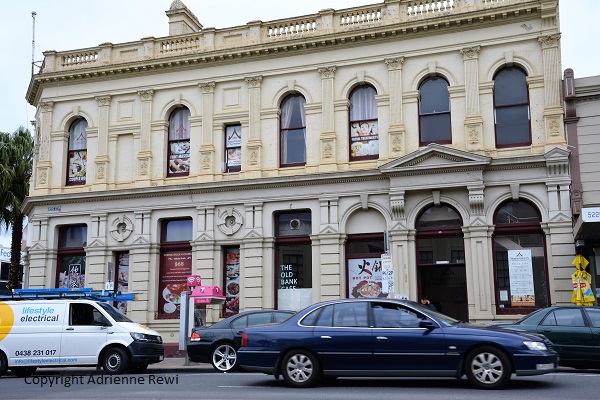
You need time to discover a lot of that I suspect, as it’s not immediately evident on a quick one hour drive. The shops were mostly ordinary at first glance, in buildings old and new; there seemed to be a proliferation of Asian restaurants, numerous tattoo parlours, pubs and Pokies places.


That said, I quickly discovered some beautiful old houses and inner city buildings. The new Geelong Library and Heritage Centre (beside the Art Gallery) (above), is striking for its geodesic dome. It was designed by ARM Architecture of Melbourne and opened in November 2015.
By comparison, the huge Geelong Government Building across the road surprises with its overt Brutalist architecture (also above).


And then there is the wonderful palm-lined esplanade, alive with walkers and cyclists –definitely a jewel in the city’s crown I’d say. With its multitude of cafes and restaurants, landscaped gardens, public art, kids’ play and swimming areas, enclosed sea baths, the restored historic carousel, it’s a major attraction for locals and visitors alike.


And then there are the quirky bollards – over 100 of them that are located in around 48 different spots along the promenade. They’re the work of local artist Jan Mitchen, who was commissioned by the City of Greater Geelong to transform old timbers and piles from a city pier that was demolished in the 1980s, into works of art. It must have been a mammoth undertaking but one well worth it. They give the whole area a great sense of fun and colour.

It was a fleeting visit but it did confirm one thing for me –another trip south, probably an overnighter – is definitely on the cards in early 2018. 


Saturday, November 4, 2017

Road Trip - With Photographs


Cropping - Ballan area, Victoria
Eucalyptus - Trentham, Central Victoria


For as long as I can remember, I’ve loved exploring unknown roads. I’ve always wanted to know about the things, the places and the people just out of sight, just out of reach.
As soon as I could ride a bike, I was off. At perhaps eight, or nine, I would set off “for a bike ride” on those long straight roads that created endless grids around the rural Waikato property I grew up on in New Zealand. I’d be gone all day and from memory, I don’t think my mother ever asked where I’d been. I sometimes wonder if she was ever worried about me.

Cropping - Ballan area, Victoria
Country pasture, Tylden, Central Victoria


I’d stop along the way to watch a group of California quails nodding their way through the long grass, or to watch a splendid golden pheasant chuckling to himself on the roadside. I might have stopped to investigate a dead rabbit and to wonder if there was any truth in the old saying that a rabbit’s tail brought you luck – and whether or not I should find a way to take it home…and what luck, if any, it might bring me.
I stopped in the summer heat to pop the bubbles forming in the tar seal; or to clamber through bushes to a bird’s nest I’d spied. It was always about Nature and enjoying the vastness of that green, green, peaceful country landscape.

Blackwood, Central Victoria

Eucalyptus, Anakie, Victoria
That urge to explore never left me. As an adult I’ve always explored the quiet back roads and I’ve encouraged my kids to do the same. I thrived in a job as a travel guide writer, travelling the length and breadth of New Zealand every two years to write a new edition. I never missed an opportunity on those trips, to venture down some side road simply because I liked the look of it. I’ve always ‘followed the signs’ – in every way.
Eucalyptus, Anakie, Victoria

Eucalyptus and  cropping, Ballan area, Victoria

 Now, living in Central Victoria in Australia, I am reacquainting myself with many places and relishing the chance to discover many more. It’s like opening a childhood treasure box all over again. As contradictory as it sounds, everything is so different here, and yet somehow the same – familiar, easy…just different enough to be exciting and similar enough to feel comfortable.

As I sit here, thinking back to my latest trip – to Geelong – I realise again, just how important the road trip itself is – more so than just about any destination. For me it is about clearing the head of daily routines and setting off in the expectation of the new. A road trip, much like a train trip, somehow loosens my imagination and I stop over and over again to see, to watch, to photograph the world around me. A trip that should take two hours, might take four. That’s the beauty of travel – making the time to really SEE.

Eucalyptus, Trentham, Central Victoria

Eucalyptus, Trentham, Central Victoria
Now that I have returned to painting, the ‘world’ I pass through is even more important to me, as I try to capture something of the essence of this new place in paint. I’m not out to replicate what I see. For me, painting is about the feeling of a place. I want to feel the freedom (as I paint), that is somehow encapsulated in the natural environment I see around me.  I want to feel again the joy I first felt when I saw the flush of red-gold of that freshly harvested wheat field I drove passed; I want feel the wonder I felt as I looked at yet another stand of gigantic gum trees – so different from the last – and I want to capture a little of the magic of their ghostly white trunks slashed with rust or plum pink.

Eucalyptus, Anakie, Victoria

Cropping, Ballan area, Victoria
Every time I go on a road trip, I collect images – literal (photography) and stored memories. And then later, when I stand in front of a blank canvas remembering those awe inspiring triggers, I freeze for a moment (sometimes for a week); and then, all at once, my brushes and knives take over and I am back there again – for a short time, deeply immersed in the beauty of this new world I have come to live in.


Related Posts Plugin for WordPress, Blogger...